Choosing between a home improvement loan and remortgage is defined by three variables: how much you need to borrow, how much equity you hold, and where you are in your current mortgage deal. A home improvement loan is typically an unsecured personal loan used to fund renovation costs without securing the debt against your property. Remortgaging, by contrast, involves replacing your existing mortgage or adding a further advance to release equity secured against your home. The right choice between these two home renovation financing options depends on project size, equity, and timing, and getting it wrong can cost you thousands in unnecessary interest or early repayment charges.
How borrowing amount and project scope shape your choice
Project size is the most reliable starting point when comparing home improvement financing options. Unsecured personal loans suit smaller projects in the £3,000 to £25,000 range, with repayment terms typically running three to seven years and higher monthly payments than secured borrowing. This means a £15,000 kitchen renovation is often well served by a personal loan, provided your credit profile supports a competitive rate.
For larger projects, the calculus shifts considerably. Remortgaging is the most cost-effective route for projects exceeding £30,000, spreading borrowing over a longer mortgage term and offering lower interest rates than unsecured products. A full loft conversion or rear extension costing £60,000 would carry a significantly higher monthly burden on a personal loan than on a remortgage, even accounting for the longer repayment period.
Your loan-to-value ratio (LTV) and credit profile also determine which route is available to you. Lenders offering competitive remortgage rates typically require an LTV below 80%, meaning you need sufficient equity built up in your property. If your equity is limited or your credit history is imperfect, an unsecured personal loan may be the only accessible option, albeit at a higher rate.

- Personal loans require no property valuation and no conveyancing, making them faster to arrange.
- Remortgages and further advances are secured against your property, which lowers the rate but increases the risk if you cannot maintain repayments.
- Your existing LTV determines how much equity you can release through remortgaging.
Pro Tip: Before applying for either product, obtain a current property valuation estimate through tools such as Zoopla or Rightmove to understand your approximate LTV. This single figure will tell you whether remortgaging is a realistic option.
What are the cost and repayment differences?
Interest rates and total repayable amounts tell very different stories depending on which product you choose. Unsecured personal loans carry higher interest rates than mortgage products but run over shorter terms, which means your total interest cost can be lower than it first appears. A £20,000 personal loan at 7% over five years costs less in total interest than the same sum added to a 25-year mortgage at 4.5%, even though the monthly payment is higher.
Remortgaging offers lower monthly payments through rate and term spreading, but total repayable amounts including fees and ERCs provide a far clearer financial picture than APR or monthly payment alone. A homeowner who adds £40,000 to their mortgage at 4.5% over 20 years will pay significantly more in cumulative interest than one who takes a personal loan at 8% over seven years, despite the mortgage appearing cheaper month to month.
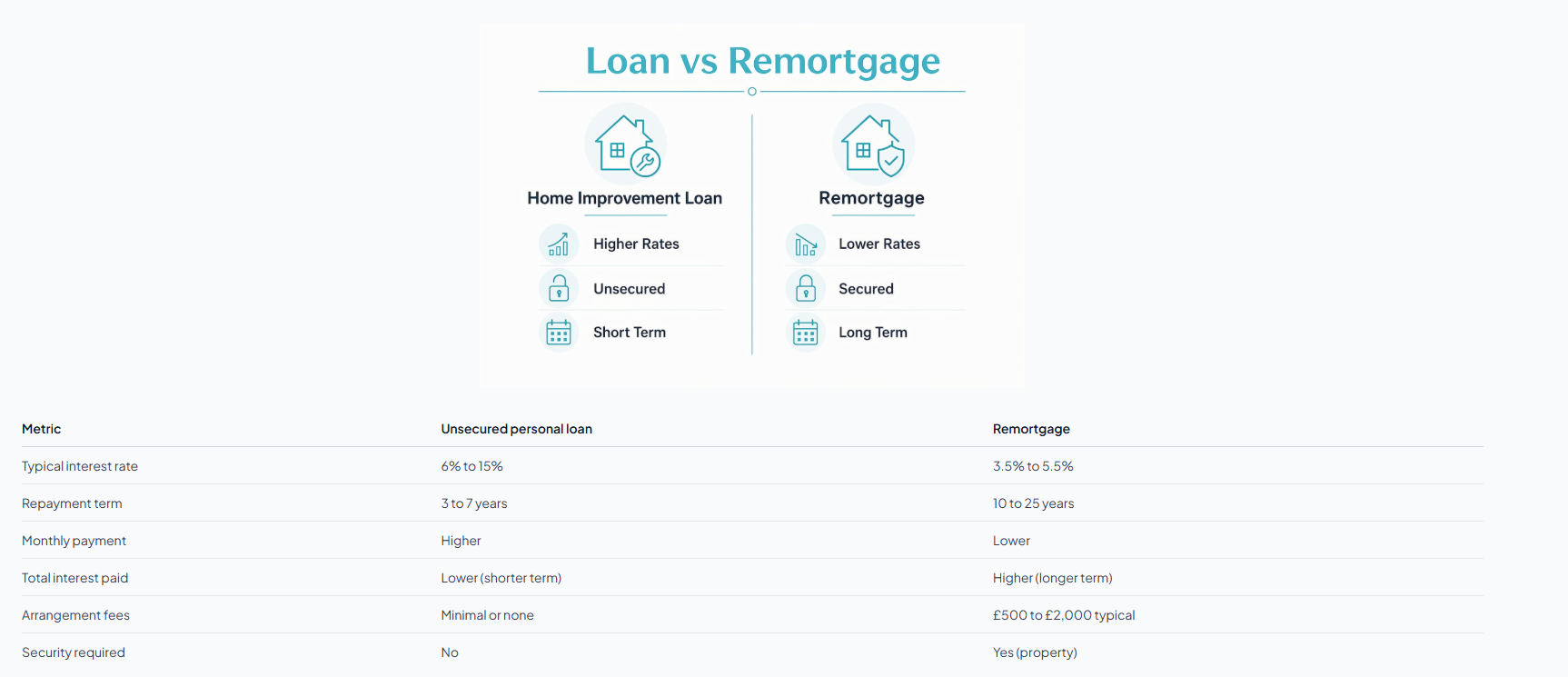
Arrangement fees, valuation costs, and legal fees add to the true cost of remortgaging. These can total £1,500 to £3,000 depending on the lender and product, which is a meaningful addition for smaller borrowing amounts. For a £15,000 project, these fees alone can make a personal loan the more economical choice even if the headline rate is higher.
Pro Tip: Run a side-by-side total repayable comparison for both options, including all fees, before committing. The Mortgage Genie's advisers can model both scenarios against your specific borrowing need and property equity position to give you a precise cost comparison.
How does timing affect your remortgage vs loan decision?
Timing is the factor most homeowners underestimate when weighing up home improvement financing options. If you are mid-way through a fixed-rate mortgage deal, leaving it early triggers early repayment charges (ERCs). ERCs typically range from 1% to 5% of your outstanding mortgage balance, reducing year by year as you approach the end of your fixed term. On a £250,000 mortgage, a 3% ERC amounts to £7,500, which can eliminate any rate saving from switching.
A further advance from your existing lender is often the most practical solution when you are mid-fix. A further advance can be arranged in approximately four to eight weeks, is usually faster and simpler than a full remortgage, and frequently avoids ERCs entirely because you remain with your current lender on your existing deal. This makes it a strong middle-ground option for projects in the £25,000 to £50,000 range when timing is not ideal for a full remortgage.
For homeowners approaching the end of their fixed term, the timing opportunity is clear. Starting your remortgage process three to six months before your deal ends allows you to lock in a competitive rate, avoid ERCs, and align your renovation funding with your deal renewal. This is the optimal window for combining a rate switch with a capital raise for home improvements.
Consider these timing scenarios before deciding:
- Year one or two of a five-year fix: an unsecured personal loan or further advance is likely more cost-effective than paying a 4% to 5% ERC.
- Year four or five of a five-year fix: the ERC is lower and a full remortgage with capital raising becomes more viable.
- Fixed term ends within six months: begin your remortgage process now to avoid rolling onto your lender's standard variable rate (SVR).
- You need funds within four weeks: a personal loan is the only realistic option, as remortgages require valuation and conveyancing.
What practical steps should you follow to arrange either option?
The application process differs substantially between a personal loan and a remortgage, and understanding each sequence helps you plan your renovation timeline accurately.
For an unsecured personal loan:
- Check your credit report via Experian, Equifax, or TransUnion before applying to identify any issues.
- Compare rates across multiple lenders using eligibility checkers that perform soft credit searches, which do not affect your score.
- Submit your application with proof of income, recent payslips or tax returns, and bank statements.
- Receive a decision, often within 24 to 48 hours, and funds within three to five working days of approval.
For a remortgage:
- Obtain a current property valuation estimate and calculate your approximate LTV.
- Engage a specialist mortgage broker, such as The Mortgage Genie, who can access over 90 lenders and match you to the most suitable product.
- Submit a full application including proof of income, identity documents, and details of your existing mortgage.
- A formal valuation is instructed by the new lender, followed by conveyancing handled by a solicitor.
- Completion typically takes six to twelve weeks from application, depending on lender and solicitor speed.
For staged renovation projects, aligning funding drawdown with build phases avoids paying interest on unused funds and improves cash flow management. Mortgage-based funding requires prior valuation and is released as a lump sum, so unsecured loans can offer more flexibility when contractor schedules are phased across several months.
Pro Tip: Ask your broker to request a decision in principle (DIP) from multiple lenders before committing to a full application. This protects your credit score and gives you a clear picture of available rates without triggering hard searches.
Obtaining multiple remortgage quotes is not optional if you want the best rate. Lenders price risk differently, and a broker with access to a wide panel will consistently find better terms than a direct application to a single high-street bank.
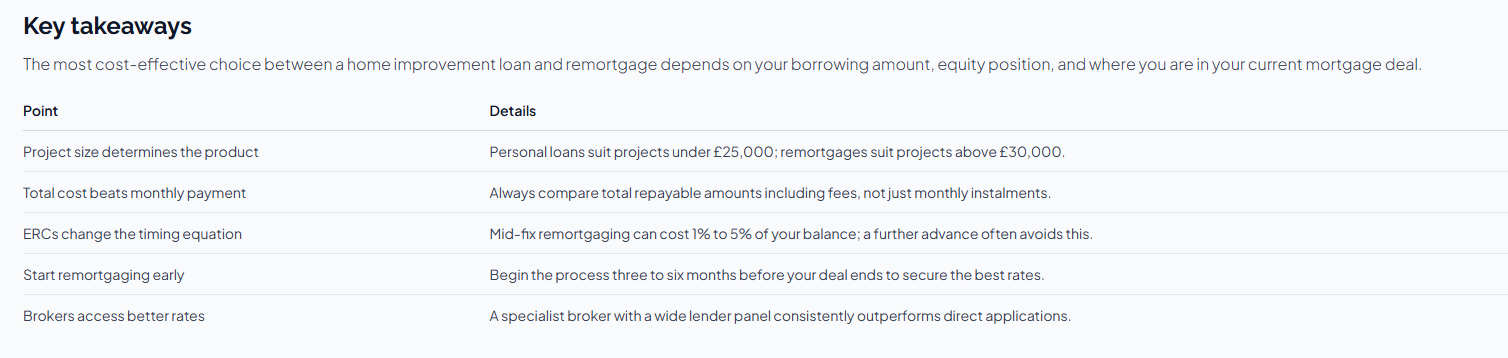
Key takeaways
The most cost-effective choice between a home improvement loan and remortgage depends on your borrowing amount, equity position, and where you are in your current mortgage deal.
Why I think most homeowners get this decision backwards
Most people I speak with start by asking "which option has the lower rate?" That is the wrong question. The right question is "which option costs me less in total, given my specific mortgage position right now?"
I have seen homeowners take a remortgage at 4.2% and end up paying more than a neighbour who took a personal loan at 8.5%, simply because the remortgage carried a £7,000 ERC and added 18 years of interest to their balance. The numbers only make sense when you model them in full.
The other mistake I see regularly is treating a further advance as a last resort. It is often the smartest first move. It is quicker, it avoids ERCs, and it keeps your existing deal intact. Many homeowners do not even know it exists as a product.
My practical advice: before you do anything, find out exactly when your current fixed term ends and what your ERC schedule looks like. That single piece of information will tell you more about your best funding route than any rate comparison table. Then speak to a broker who will model both options in full before you commit to either.
— Matt
How The Mortgage Genie can help you choose the right option
Deciding between a home improvement loan and remortgage requires precise knowledge of your equity, your current mortgage terms, and the full cost of each route. The Mortgage Genie's advisers work with over 90 lenders and use a pre-application matching process that connects you with the lenders most likely to approve your application at the best available rate.
Whether you need to compare remortgage options for a large renovation project or want to understand how a personal loan might affect a future mortgage application, The Mortgage Genie provides tailored, free initial advice specific to your situation. The team handles the full process from valuation through to conveyancing, so you can focus on your renovation rather than the paperwork. Speak to a mortgage adviser today to get a clear, personalised comparison of your options.